

2·
23 days agomaybe a hair tie or marker pen. sometimes tools (mainly wrenches). uhh not really any specific pockets we use for stuff, ,

she, her, etc. (for any one or all of us).
plural, and may use both “we” and “i”. it’s complicated, but “i” is most often by the girl amongst us who does a lot of the feeling emotions and other stuff, as she is most often “at front”.
that girl (we will call her tani) runs much of the show, and does a lot of the feeling and perception, but a lot less thinking. while most thoughts posted are contributed to by multiple of us, tani’s thoughts in particular are again, more emotional. examples: “we love the pretty views” and “i wanna snuggle our plushies so badly”. the former could be shared across many of us, but for the latter, many of us do not do that direct decision making to begin with; really only tani does.
still, others of us may use “i” too!
all pictures photographed by us and published here are under the CC0 1.0 public domain dedication unless otherwise noted
maybe a hair tie or marker pen. sometimes tools (mainly wrenches). uhh not really any specific pockets we use for stuff, ,
meow mrrrp mroww
tyy, the socks seem to be a favorite among the crowds. yesterday at protest, we also wore them and received no less than fourteen compliments about them. further ones are still VERY welcome though hehe :D
they are also so so super comfy. if you haven’t any knitted stuff, do get some!!


us testing out a fender we designed for our go-kart a couple weeks ago
the fender on the left wheel is the third iteration. the second iteration was on the right wheel but was ripped to shreds (this is why we test stuff).

the instance i use does not have downvotes. i personally like this, as if someone disagrees with something, they must express that via their own words, which i find to be a lot more productive and useful!
my basis is, if the comment contributes meaningfully/helpfully to the subject at hand—whether that is via explanation, personal storytelling of something relevant, something funny or kind that makes other people smile/feel joy, among many others—then i elect to give an upvote.
if it is unintelligible to me (like a reference i don’t get), overly provocative, actively harmful (anti-vaccination stuff etc.) or otherwise not made in a real effort to contribute anything useful or interesting, then i elect not to give an upvote.
that is just my reasoning though :)

the compass set at my drafting desk has the marking
GERMANY
U.S. ZONE
it predates even west germany! i’m pretty sure the desk itself is even older.
i may perhaps take a photo sometime :)
from what i’ve gathered, many earlier EVs were more so “luxury” vehicles, and a lot of them were made by tesla, notorious for shoving wireless connectivity in vehicles. those other luxury EVs decided to follow suit with that!
but note that “many” i sneaked in there. there were absolutely some that weren’t spyware machines! the first that come to mind are the earlier models of the nissan leaf and chevy volt (well, there is onstar, but it is not so hard to disable), but there are certainly others. there is no valid reason for the spyware, i mean these cars easily did without it (minus again, onstar…)!
as for an electric van, i knew a (ex-)teacher who did just that! from what she said, she pulled a couple of the major drivetrain components (motor, battery, differential etc.) from a crashed nissan leaf, hooked up an aftermarket controller, and from what i heard the most fiddly parts were the charge port and getting the axles dealt with. i don’t know if she got custom axles made or if she just mashed together the axles from both vehicles, but she said it was ultimately a nice vehicle to drive around.
i have! the fun part is while the malfunction lights weren’t lit up, neither was anything else :D
my friends old toyota 1-ton pickup! i don’t really “drive” it per se (i don’t even have a drivers license hehe), but i do occasionally operate it myself to tug/tow heavy stuff around very short distances. honestly haven’t even touched any higher gears than second.
a purchase of an old 80s subaru wagon may be in the works however, but only time will tell :)
above all, the biggest issue i see here is the mounting (or lack thereof) of the generator on the trailer.
please, secure your loads!!!
i found a higher quality version, not sure of the original source, and its definitely AI:

regardless though, i did look into if this is possible. no matter if the connector on the vehicle is NACS/SAE J3400 (the “tesla” connector") or SAE J1772 (CCS 1), for AC charging—which is the situation here—it will be the same (note that this will not exactly apply to vehicles using CHAdeMO, GB/T, etc.). i went with this document that briefly outlines NACS. this is the proper standard, but i wasnt able to find a copy gratis with my two minutes of searching. this should still apply to other vehicles with a CCS 1/J1172 connector, at least for AC charging!
now, since we are charging with alternating current, we have only five pins to deal with, seen here for NACS (for CCS 1, just ignore the two super giant pins, if present. otherwise it applies to CCS 1 too!):

the big two (HV + and HV -) are for supplying power, no matter the flavor of AC or DC at hand. with CCS, DC charging goes through the two big pins at the bottom, AC charging works the same way though. the ground pin is present for low voltage electronics to actually have, well, a proper reference to ground! (this is your zero volt pin).
finally, we have the control pilot, and the proximity pilot. the former is a digital interface for the vehicle and charger to communicate in depth about charging speed, battery status, etc. the latter however, which is of the greatest interest to us, handles the physical connection itself. this is where the name comes from: it handles when a charging connector is in proximity (plugged in) to the vehicle!
when measuring between the ground pin and the proximity pilot pin, if the vehicle is ready to accept a charging cable but none is plugged in, there will be five volts. if there is something compatible plugged in, resistors within the connector will pull the voltage down lower (to 1.5V), indicating that something is, well, plugged in!
here is the part of the charging connection schematic that is relevant to us:

R1 and R2 are just resistors (150Ω and 330Ω, respectively), and S1 is a (optional to implement) normally-closed switch—likely a button on the charger plug handle—that brings the voltage slightly higher (to 2.8V), to signal to stop charging and if possible, unlock the connector (if it is locking).
now, the resistors themselves are located inside the plug, and not the charger/power control unit. after all, if the vehicle manages to somehow move away, and the cable snaps off said unit, the vehicle can still be aware of if something is plugged in!
of course, if you want to defeat this, it is very simple: tape over the proximity pilot pin! as far as the charge port door goes? from forum posts i’ve seen, the vehicle will still drive, even if it’s a little whiney.
“but wait!” you say, “the vehicle can latch the connector into itself. can’t it just detect it that way?”
this would certainly vary by vehicle. for teslas, it likely can’t (or if it could, the engineers didn’t bother to). seen in this youtube video, the charge door slams into the object left in the charge port, indicating the vehicle probably doesn’t look at this.
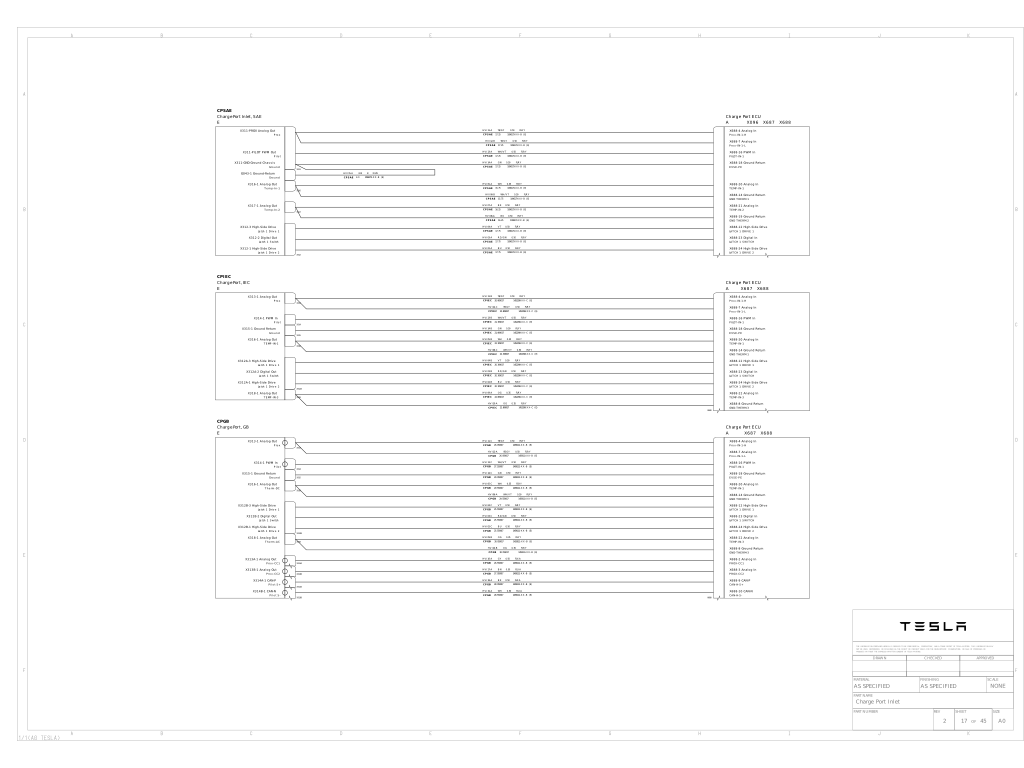
i also looked up the electrical schematics provided by tesla here (SVG):

the block on the left is the vehicle-side charging port assembly, the right is the actual vehicle computer. the three pins at the bottom handle the connector latch: X312-1 and X312-3, which power the motors, and X312-2, a switch/button in the port which is presumably what the vehicle uses to know it latched onto something successfully. remember, this is for the latch the vehicle extends—not the one that is simply mechanical and operated by the driver—and most likely does not provide enough information to tell if something is plugged in.
overall, if we are talking about teslas, your point does hold some merit; even if you snipped the charging plug entirely off a cable, the vehicle can still (if the plug is up to standards) detect it if it’s plugged in. however, something like this would not be unrealistic, even if the vehicle didn’t actually charge.
of course, this may not be the case for other vehicles! but that is beyond the scope here :)

we just went to that area yesterday!! its very rocky and lots of cliffs on the coast, and super super hilly and forested in the interior.
many absolutely do live there, and those municipalities marked on your map there are reasonably populated. but the terrain is not super great for building large stuff, and they really do not like deforestation either. it is also farther away from freeway I-5, where most stuff on the west coast is freighted by truck, and is more expensive, at least from our experiences.
the sunset on the coast is SO pretty though :)