

Good evening! I am reading up on electricity just for the fun of it. I am still a complete beginner.
With that out of the way, I wonder: are electrons negatively charged inanimate objects, perhaps particles, or are they merely negative charge with no physical form? But perhaps without there being an object to exert charge there is no charge?
An other way of asking this question would to my beginner mind be: could we tag and track an individual electron as it flows - perhaps in a piece of copper without significant voltage so that the electron doesn’t rush away in the speed of light?
I guess I want to know this in order to understand whether electrons actually loop around in a closed DC circuit in the speed of light or are they just pushing the electron in front of them, creating a domino effect, not actually traveling very far?
Please excuse my incoherent formulation. It’s late at night where I am and of course these questions come to mind when I’m trying to sleep.
no. this is what Heisenberg’s uncertainty principle is about. we cannot know both a quantum particle’s location and it’s velocity with high accuracy at the same time. if we know with high accuracy how fast it’s moving, we can only have a very vague guess of where it is, or vice versa
Usually for typical conductors I think we can learn enough about the position and momentum of our electrons to keep track of them.
Not overly precisely but enough to not confuse them with each other.
A good way to see this is that we can simulate electrons moving through states in a conductor with good accuracy, without a need to go into full quantum mechanical descriptions, in an almost classical simulation.
Of course the position and speed we are tracking there is not a typical blurred point, it will be a complicated wave spanning many neighbouring atoms in size, with different electrons being at different positions around those atoms.
But you can know which electrons are in what loose region with what distribution, and follow them through interactions where they move to different regions or change the shape of their wave. Depending on your conductor the spread may even go down to single-atom-scales in some extremes.
Measuring all electrons in a real conductor enough to tell after some time which end of it any one electron ended up at, would probably change its properties slightly due to the measurements, but done correctly it should definitely still be behaving like a normal conductor.
Here is an example of a particularly low-speed localized electron in a typical material:
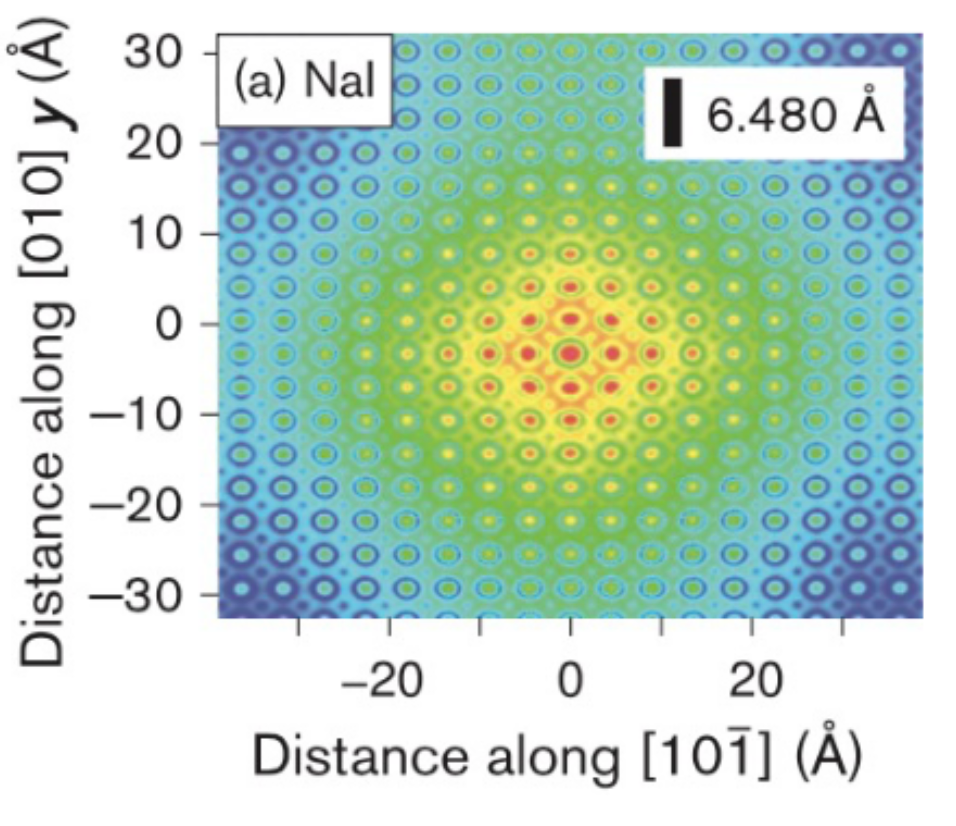
Every electron will have a patterned distribution like that. If you naively tried to measure electrons at some spot, there would be thousands strongly overlapping there, you would mess everything up. But there is no issue checking if this wide shape as shown has an electron occupying it or not.