

5·
4 days agoNo, 9GW of electricity, and they claim 16GW total. With a greater than 50% efficient gas plant.
Former account: @Redjard@lemmy.dbzer0.com
Keyoxide: aspe:keyoxide.org:KI5WYVI3WGWSIGMOKOOOGF4JAE (think PGP key)
No, 9GW of electricity, and they claim 16GW total. With a greater than 50% efficient gas plant.
What part do they make in that round thing?

I haven’t checked too deeply but I think fedora dropped the affected system between kernels 6.6 and 6.12 somewhere. 6.12+ appear to not have the modules.
Not too surprising given the system has been deprecated for a long time.
Usually for typical conductors I think we can learn enough about the position and momentum of our electrons to keep track of them.
Not overly precisely but enough to not confuse them with each other.
A good way to see this is that we can simulate electrons moving through states in a conductor with good accuracy, without a need to go into full quantum mechanical descriptions, in an almost classical simulation.
Of course the position and speed we are tracking there is not a typical blurred point, it will be a complicated wave spanning many neighbouring atoms in size, with different electrons being at different positions around those atoms.
But you can know which electrons are in what loose region with what distribution, and follow them through interactions where they move to different regions or change the shape of their wave. Depending on your conductor the spread may even go down to single-atom-scales in some extremes.
Measuring all electrons in a real conductor enough to tell after some time which end of it any one electron ended up at, would probably change its properties slightly due to the measurements, but done correctly it should definitely still be behaving like a normal conductor.
Here is an example of a particularly low-speed localized electron in a typical material:
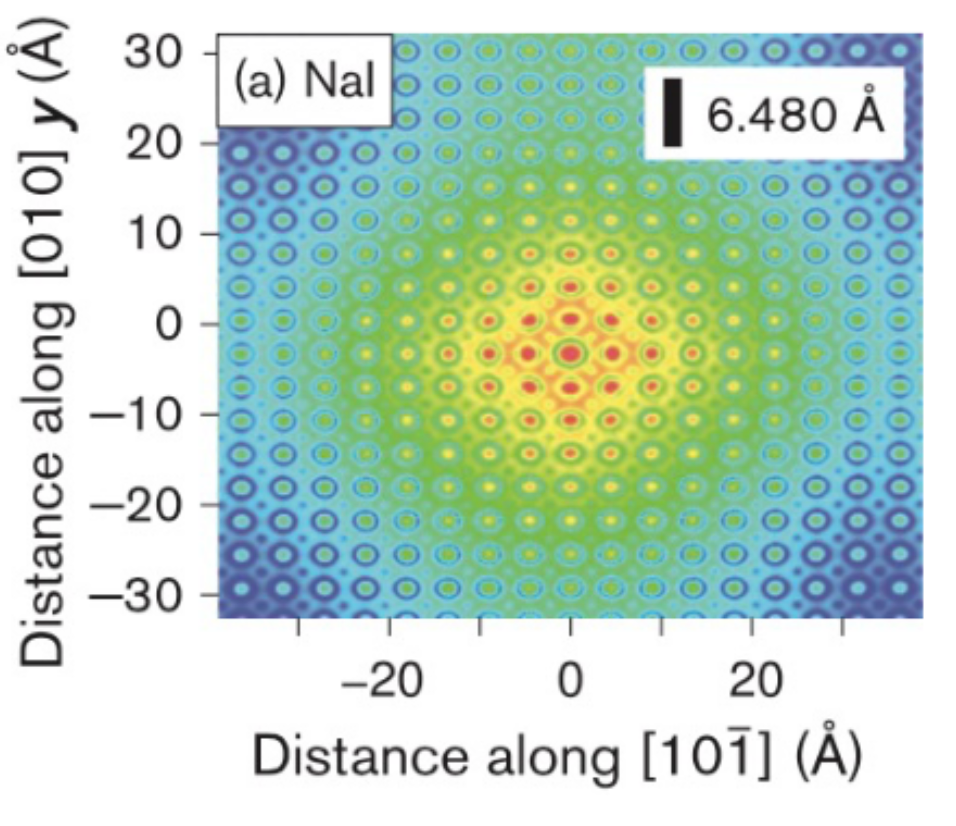
Every electron will have a patterned distribution like that. If you naively tried to measure electrons at some spot, there would be thousands strongly overlapping there, you would mess everything up. But there is no issue checking if this wide shape as shown has an electron occupying it or not.
They are usually very particle like.
The extreme is semiconductors and band fuckery. There you have a lot of stuff that only makes sense with electron particles jumping around accelerating and colliding. You can talk about mean free path in conductors etc.
They do however interact a lot via their charge, so electricity propagating is usually a pressure wave mostly visible in the electric field, with electrons only doing very little, moving slowly. This field is however driven by the electrons, so it really is electrons doing that.
Resistance, diodes, even heat conduction (/“resistance” to heat transfer) directly follows from electrons as particles interacting with atoms or themselves.
I think you loose these particle effects in (type 1) superconductivity. Your cooper pairs are so smooth and non-interacting they might aswell be clouds if you don’t zoom in enough (quantum circuits sometimes have singular amounts of those charge carriers running in circles in a tiny superconductor loop).
However, when you look into why superconductivity is a thing and at what temperature you see it etc., that once again derives directly from the properties of electrons and the layout of your material.
Or maybe you meam do electrons have dimensions and physical properties? That they don’t.
They have a charge, speed, momentum, … but interaction is via the charge. That is what touching means, there is no further collision (technically there is electroweak force stuff).
They are not points either because qm eave blurriness stuff.
For your specific electron movement questions. I think electrons in metals under normal current where the metal heats only a litte move at snails pace, literally. In semiconductors it’s a lot faster, about bullet speeds if you push some current. Metals could probably also get to bullet speeds but they would vaporize and explode due to the electric and magnetic fields. Faster than that isn’t really feasible. Btw. the random motion at room temperature is also at that scale, though due to quantum effects it’s not a bouncing around.
So when you have circuits operate near light speed, that is an electron pressure wave not electrons. The electrons react via quantum fuckery, but changing between speeds and positions at the slow pace described. The reaction is carried on via the electric field. The speed of electricity is the speed of interaction between electrons, not the speed of electrons.
Without the electrons reacting and causing their own electric field changes, the electric field still carries the effects but it quickly dilutes. This is called radio (depending on the timescale of your change), and while it does transmit electricity it does so very weakly, nothing compared to the “continuously electron reinforced short range interaction” wire.
Molly supports unified push
Notification logging is usually done by some other part of android as far as I know. GMS is the typical way to deliver notifications and is a far more serious privacy concern, since it also directly passes googles servers and is not encrypted. However as others mentioned, signal does not send contents there, message notifications with the message contents stay on device.
This is about a history of notifications locally on the phone.
This is implemented outside of gms at least on my rom, and in the past I have also installed a separate app to do the same.
If you log your notifications … that log can leak your notifications.

It’s an early step. Good chance it doesn’t work well in humans, and many side effects can’t be discovered until human trials either.

Since noone went into details on it yet,
LCDs are already transparent. They filter light, and usually their back is simply lit uniformly white. Instead you can use them freestanding and get a pane of glass you can selectively darken. This is sometimes used in custom pc cases to show info on a glass sidepanel.
Unfortunately the way LCDs work means they always darken by 50% at the brightest, much more if you add color filters to escape b/w hell. If eink develops further and matches lcds in speed, it is probably possible to change the materials in one to make the pigment not block light when it is on one side.
As for getting brighter, that is on the edge of viable, since we are just short of microled screens. There are already larger screens using that technology, and if you really wanted to you could make small screens too, it would just be really expensive and manual. Viable mass production is still in development, current methods have too many dead pixels.
So within a few years and with some development to adjust eink to the purpose, it should be possible to get a pretty transparent pane that can become opaque and specular or matte in any color and saturation and brightness, and also emit light at will on its surface.
The driver electronics should be very shrinkable and could probably be made small enough you literally couldn’t see them. The limit is probably gonna be the power source, which will likely have to wait for some far off material science magic like graphene capacitor batteries that manages to make it transparent so you can stick it inside the pane of glass.
Making text flow naturally, grouping and ordeeing information, good writing.
You can verify two textst have the same facts and information, yet one reads way better than the other. But writing a text that reads well is quite hard.
If you don’t habe the ability then you would do what you would have 5 years ago: not do it
Either submit without, or not submit at all.

Not sure how far you wanna go. I know my way around mediawiki from the sysasmin side (installing, updating, installing extensions and themes, configuring weird features like ldap auth, …), the admin side (css, users and groups, templates and lua scripts), and some moderation (editing etiquette on wikipedia and a few other wikis, typical style guides, organization of pages and overview pages).
I’m quite busy lately, but you could ask me some questions via dm for example and I would be willing to do some small things.
This. Aegis does all of the points except offsite backups. And for good reason.
The Aegis app has no network permissions at all, which is obviously a massive boost for security and privacy. And besides, off-device backuping is a nightmare.
Syncing the Aegis backups made on change to some other server is better handled by a great dedicated app. Syncthing is the best such program (by far), though for the few files involved here nextcloud would work just as well.
I also find it to be very slow on many networks, and even in ideal conditions it might get 2MB/s when the phone has a 10MB/s connection.
For photos and predictable stuff I thus use syncthing, and the odd very large thing I send using scp with termux.

Clarity can also be achieved with a 4k panel. Once your panel gets over 600ppi it’s gonna blow an eink screen out of the water at its own game. Those phones were barely ever made only Sony even tried. Probably due to battery life, or maybe noone realized what they do to the reading experience.
Either way we’re gonna improve battery life and maybe even get microled before eink ever gets competitive with emissive screens. Someone is bound to rediscover that you never truly needed eink for comfortable reading, just a significant increase in resolution.
I interpret this as the “boundary” being one-way away from us, with us at the “top of the potential well”. As opposed to the more commonly proposed idea that the universe is inside a black hole.
Hawking radiation is based on the curvature of the event horizon, so in this case I think it should balance negatively, sucking out energy from the universe, probably by releasing negative energy particles in the particle perspective.
This doesn’t make physical sense, which matches that such an event horizon shape also doesn’t make sense and shouldn’t be able to be created I think.

It’s also completely fine under all international law.
Following copyright law is more like a trade agreement, so if you feel wronged enough as a nation it’s completely uncontroversial to suspend all or all international copyright law and deal with the consequences (mainly the us being very salty about it).
The EU contingency for a US attack on Greenland for example is among other steps to suspend all US copyrights recognition and starve the US service industry.
I was already in the middle of posting this to !dontyouknowwhoiam@lemmy.world before seeing the remainder of your post :)
!anythingbutmetric@discuss.tchncs.de