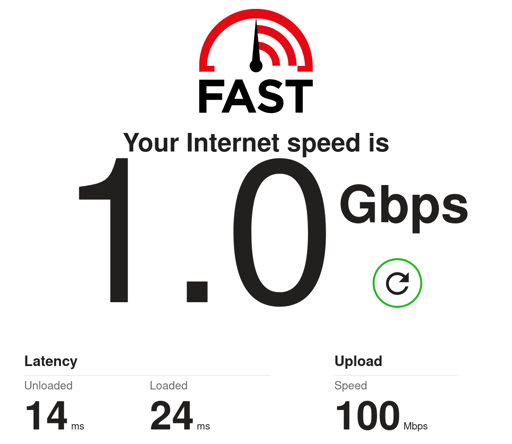
Six years ago, I nearly got my ISP to upgrade our fibre connection to 1Gbps. As I said at the time: This is a curmudgeonly post which is going to look ridiculously outdated in a few years. What's the point of Gigabit broadband? Well, it's a few years later and Virgin Media have just given me their Gig1 package for £30 per month. Nice! With all the inflation related price rises, it's great to …


Tbh, I don’t think the post is bad at all. If you have special high-bandwidth use cases that require massive speed you know that already and then the article isn’t for you.
If you say you “didn’t have fiber” I’m guessing you were on 50MBit VDSL? Then, of course, switching to gigabit makes sense.
In the blog post the author explicitly doesn’t say “Go get VDSL”, but they compare Gigabit with 500MBit. That’s not nearly that much of a difference, you’ll still be able to play a new game minutes after you bought it, but just twice as many minutes. If that at all, because if you have wifi in your home, it will likely limit your bandwidth to less than 500MBit in real use anyway.
The main point of the post is to show whether a regular user really benefits from Gigabit, and no, they don’t. Their netflix stream will not improve when going from a few hundred MBit to a Gigabit. Neither will most of their experience.
If you are lucky enough to live in a place where Gigabit costs nothing, sure, might as well. The only provider who serves Gigabit to my home wants €65 per month for that, €780 per year. That’s a lot of money for something that maybe saves me a few minutes once or twice a month.
Where I am, I can pay for gigabit duplex or 500Mbps cable. The issue is that the upload speed on the cable circuit is only 30Mbps and I have multiple people streaming from my Plex server, playing games on servers I run, or I might be checking my security cameras while I’m out and about. The only time 300Mbps isn’t enough for me is on big files from beefy CDNs like Steam, but 30Mbps gets constraining pretty quick.
Not much of a difference in price either in most places. usually it’s like 10-20% extra to double the speed.
This is true, but to claim there is no point is false, saying that for most 500 Mbit/s is better value would be a way better headline IMO, heck most people will do fine with 100 Mbit/s.
We pay €58 for 1 Gigabit, and I think 500 Mbit is €49 if I recall correctly, so the difference is not a lot.
Of course it also matters if you are just a single person or a family of more people.
PS:
There was a use I forgot to mention, and that is when upgrading my OS, I use a rolling release distro of Linux, and I have quite frequent updates, most are small and finish in a matter of seconds, and even the biggest updates can usually finish within a couple of minutes. This is quite nice too.
Anyways of course lower speeds can be better value depending on the use case, but for us the cost of higher speed is negligible, and it’s nice for families not to be slowed down just because someone is using a bit of bandwidth.
A relevant part is that double the speed doesn’t save the same time.
So e.g. if a download takes 100 minutes on 10MBit, you save 50 minutes by doubling the speed.
The same download would take 10 minutes on 100MBit, doubling the bandwidth would only save 5 minutes.
And on 500MBit it’s two minutes, so doubling the bandwidth only saves one minute.
We are deep into diminishing returns here.
€58 vs €49 means an extra €108 per year. That’s quite a sum.
In my case going from the 150Mbit/s I have to gigabit would cost me €35 extra per month, €420 a year, yeah, that’s not worth it to speed up some background downloads.
I’m on Fedora, updates are frequent as well, but since they download in the background I hardly care about the speed. I see there’s a new update, so I start the download in the beginning of the day. It finishes within half an hour or an hour or so, while I continue doing my stuff, and in the evening when I’m done I run the actual update if it requires a reboot.
This is simply not true, of course it isn’t entirely linear, but for big downloads you actually get pretty close to the full benefit of the speed, when the servers can handle it.
When the speed goes up, latency also goes down, making response times faster too.
Sounds a lot like your Fedora update is single threaded, which is a huge limitation. I start updates manually and monitor the whole process, and the whole process is finished in a couple of minutes for a big update. A single package can be literally less than 5 seconds for download, integrity check and installation. Firefox is among the most frequent single package updates, and that generally takes 5-6 seconds.
What is not true?
Do the math yourself, it’s only grade school level:
A download takes 100 minutes at 10Mbit. How long does it take at 20Mbit and how many minutes are saved?
The same download takes 2 minutes at 500Mbit. How long does it take at 1000Mbit and how many minutes are saved?
This calculation doesn’t even take into consideration that most servers don’t allow for gigabit downloads and that most wifi connections also don’t allow for gigabit.
and, not to forget, just because you have 1gbps or faster download available, doesn’t mean the other end and the pipes in between can deliver at that rate.